







What are the Phlegraean Fields?
The Phlegraean Fields are the lands that the Greeks called flègo (burning lands), due to the presence of natural phenomena: thermal springs and fumaroles. This area is in fact a volcanic region.
What is bradyseism?
Bradiism is a seismic phenomenon that consists of slight movements of elevation or lowering of the ground (a few centimeters per year).
Where are the Phlegraean Fields located?
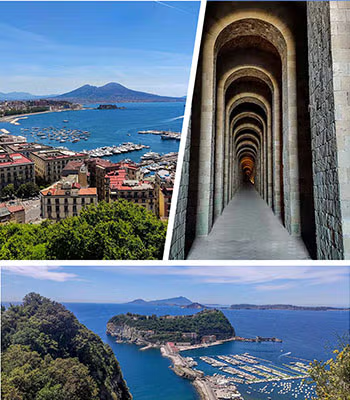
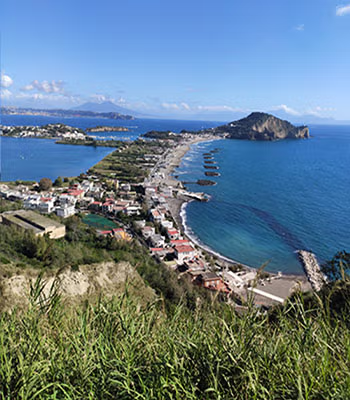
The Phlegraean Fields are located in the Campania region and comprehends the entire Gulf of Pozzuoli, part of the city of Naples and part of its bay, the territory north-west of the Neapolitan city, the islands of Ischia and Procida, the city of Pozzuoli, the peninsula Phlegrean (Bacoli and Monte di Procida) and the city of Quarto.
Was there ever volcanic activity in the Phlegraean Fields?
In the past, 3 very powerful volcanic eruptions have occurred in the Campi Flegrei. The first two were very intense: 39,000 years ago and 15,000 years ago. Then another in 1538, less powerful but which gave rise to a new volcano, the "Monte Nuovo" (near Lake Lucrino).
Phlegraean Fields, learn what you can visit in this region
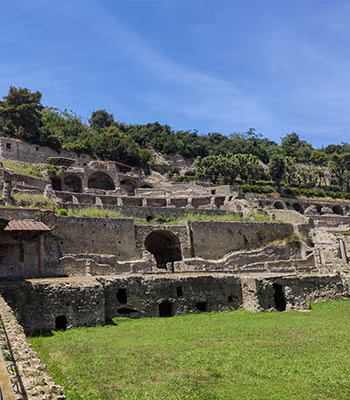
Due to the presence of many hot springs, the Phlegraean Fields were once one of the most important holiday destination of various peoples, especially the Romans who built cities, monuments, wellness centers, places of worship, etc. and today it is possible to visit the ruins of the Flavian Amphitheater, the Castle of Baiae with the Archaeological Museum, the archaeological site of Cumae, the remains of the Baths of Baia and much more.
The Phlegraean fields and the archaeological park of Cumae
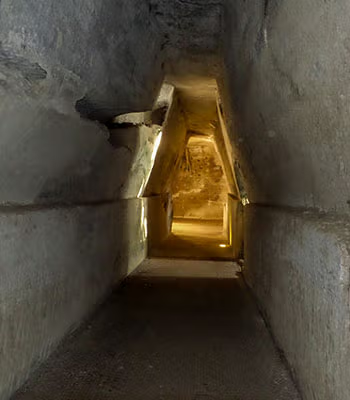
In the Phlegraean Fields You can visit the archaeological remains of the firts Greek colony of the 700 BC / BCE: the city of Cumae with the temples of Jupiter, that of Apollo, the cave of the Sibyl etc.
... Visite theArchaeological excavations of Cumae page...let's go...


The Phlegraean fields and the archaeological park of Baiae
The Phlegraean fields were places of relax and holiday destination for the Roman aristocracy and a huge spa complex was built on the hill of Baiae. The Roman builders were really amazing, they used the natural hot springs of this volcanic region to create real spa rooms... do you want to know more? please visit the page of ancient roman baths of Baiae


Pozzuoli, Italy and the Flavian Amphitheater
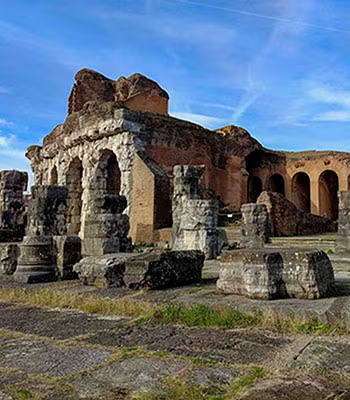
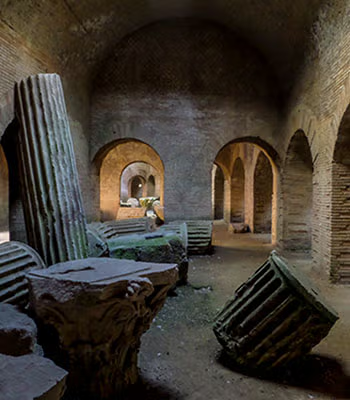
In the Phlegraean Fields, more specifically the city of Pozzuoli, at the end of the 1st century AD, the Romans built the third largest amphitheater in Italy. It was built because the smaller one could no longer contain the growing numbers of spectators. Do you want to know more? please click on the page of Flavian Amphitheater of Pozzuoli


Castle of Baiae and the museum of the Phlegraean Fields
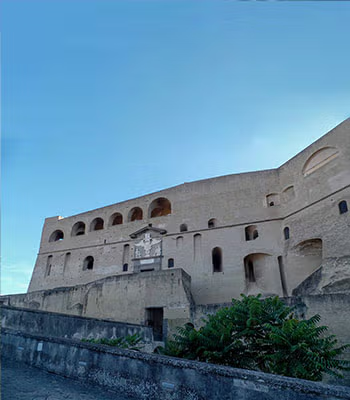
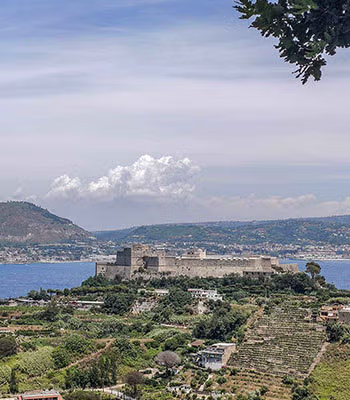
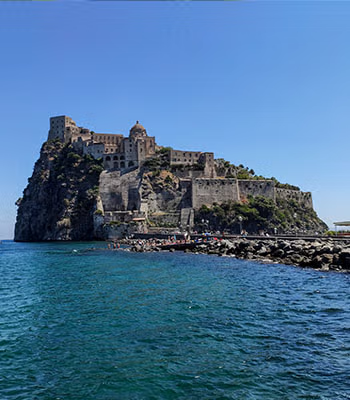
In the Phlegraean Fields another place that you cannot miss is the Aragonese Castle of Baiae, a military fortress built in 1495 by the King of Naples Alfonso II of Aragon. It is thought to have been built on the Julius Caesar imperial residence. Inside the caslte one finds the archaeological museum of the Phlegraean Fields. Click here to visit the page of Castle of Baiae and his Museum.


Pozzuoli (Italy), Macellum
The Macellum of Pozzuoli is the ancient Roman market also called "Temple of Serapis" and it's located in the lower part of the city. Today it's just visible some ruins and on the columns you can see clearly some holes dug by lithodomes, sea dates. These small furrows are essential elements to study the phenomenon of bradyseism, because in the past the level of the ground has fallen, that of the sea has risen by submerging the lower part of these columns, so now looking at the holes, as the water receded, we can understand the ground level that there was in the past.


To reach the Macellum in Pozzuoli, please click on next picture

How to reach the Macellum of Pozzuoli by public transport
From Naples by train: at Montesanto station take Cumana (direction Torregaveta), then get off at the Pozzuoli stop. Now to get to his destination you just need to walk for 2 minutes, so from the exit of the station cross the road and turn right, after 200 meters You get to the destination.
The Phlegraean Fields and the "RioneTerra" of Pozzuoli


The "Rione Terra" is the ghost town of Pozzuoli where we can also finds the cathedral of the city, one time it was the temple of Augustus. Info and reservation: rioneterapozzuoli.com
How to get to the "Rione terra" in Pozzuoli
From Naples by train: in Montesanto, take the Cumana (direction Torregaveta), then get off at the Pozzuoli stop. To get the Rione Terra you just need to Walk for 5 minutes, so when leaving the station turn left, after about one hundred meters you arrive in a little square with a small public garden, continue straight ahead and take the small lane in front of you. At the end of this small alley, turn left and after another one hundred meters you will find stairs located just beforea little arch. Take the stairs and when you reach the top turn right and immediately right again. You have arrived at your destination.
The Bradyseism and the submerged park of Baiae
The Bradisism is a seismic phenomenon, a slight movement of raising or lowering of the ground (a few centimeters per year) that continuously changes the height of the ground level. The Lucrino lake in the past did not exist and in its place there was the sea, so after centuries the level of the Ground has increased closing part of the sea and the lake was formed. Just a few kilometers away one finds the port of Baiae and under the sea there is a submerged archaeological park, one time it was the ancient port Juilus that in the 1st century BC / BCE it connected Rome to the East. Now you can visit the submerged remains by a boat with round windows (portholes) or by diving with experienced divers.
Excursions with "Cymba" the boat with the portholes
Address: Via Molo di Baia, 80070 Bacoli NA
Tel: +39 349 497 4183 - Reservations required
Swiming with experienced divers
Address: Indirizzo: Via Molo di Baia, 14 - 80078 Bacoli (Na)
Tel .: +39 081 8688868 - Reservations required


How to reach the port of Baiae by public transport
From Naples by bus:
in Piazza Garibaldi bus station (next to Naples central train station) take one of the buses for "Torregaveta" or "Monte di Procida", but you must get off at the "Baia" stop (Baiae), the journey takes about 1 hour. More info here.
From Naples by train:
in Montesanto, take the Cumana (direction Torregaveta) then get off at Fusaro stop and walk to the Archaeological Park of Baiae (about 1 km, 20 minutes walking), but you can also take the bus, so walk until Vanvitelli street (2 minutes from Fusaro station). It is the road in front of the Bourbon park, that of the Casina Vanvitelliana (the little cottage in the middle of Lake). So with the park behind you, the stop is the first on the right and you can buy the ticket in the "Illiano Tabacchi"(tobacco store), which is just opposite the stop. Take the BUS "Torregaveta (Staz. Cumana) - Ospedale La Schiana" or "l'Archebus Flegreo" and get off at the Archaeological Park of the Baths of Baiae (ask the driver). From there, simply walk down the stairs near to the park entrance and then when you get down you just need to cross the road to get to the Port of Baiae.
Casina Vanvitelliana, the cottage in the middle of the lake
In the Phlegraean fields there is another magical place to visit. In the middle of Fusaro lake one finds a small and charming hunting house, the "Casina Vanvitelliana", wanted by King Ferdinand IV of Bourbon and built in 1782 by Carlo Vanvitelli, the son of Luigi the architect of the Royal palace of Caserta.


Click on the next photo to reach the Casina Vanvitelliana

How to get to Casina Vanvitelliana by public transports
From Naples, take the Cumana train towards Torregaveta and get off at the Fusaro stop, then from the station walk for 1 minute and you will arrive at the Casina Vanvitelliana.
The Solfatara volcano

The Solfatara volcano
The Solfatara volcano it's a place where many fumaroles and gases are visible, but now unfortunately it is no longer open to visitors.
To see it at least from above I suggest you to take the road that goes up (next to the entrance), so walk it for 200 meters until you can see the fumaroles. You can also get there by car by clicking here and to make a u-turn continue to go up a for a bit, until you arrive in front of the entrance to the hotel degli dei, where you have more space to change of direction and come back down.
Other places to visit in the Phlegraean Fields.
On the shore of Averno lake one finds the temple of Apollo, a large spa room from Roman times. It was initially believed to be the cave of the Sibyl of Cumae, the priestess of the Greek god Apollo. The legend says that this cave was the entrance of hell described in the Aeneid by Virgil, a 1st century Roman writer.
The Mirabilis Pool, a large cistern built in Roman times around the 10th century AD / C.E. It was able to contain 12,600 m³ of water coming from the sources of the Serino in Irpinia (Province of Avellino) and transported by one of the most impressive Roman works of that time: the Augustan aqueduct.
The Cento Camerelle (an old cistern of an huge imperial villa)
Agrippina's Tomb, Roman ruins where it is believed that the mother of Emperor of Rome Nero was buried.
Large monumental necropolis (including the via Celle necropolis).
The Napletan crypt (also called cave of Virgil or cave of Posillipo): a tunnel dug in the tuff to connect Naples to the Phlegrean Fields.